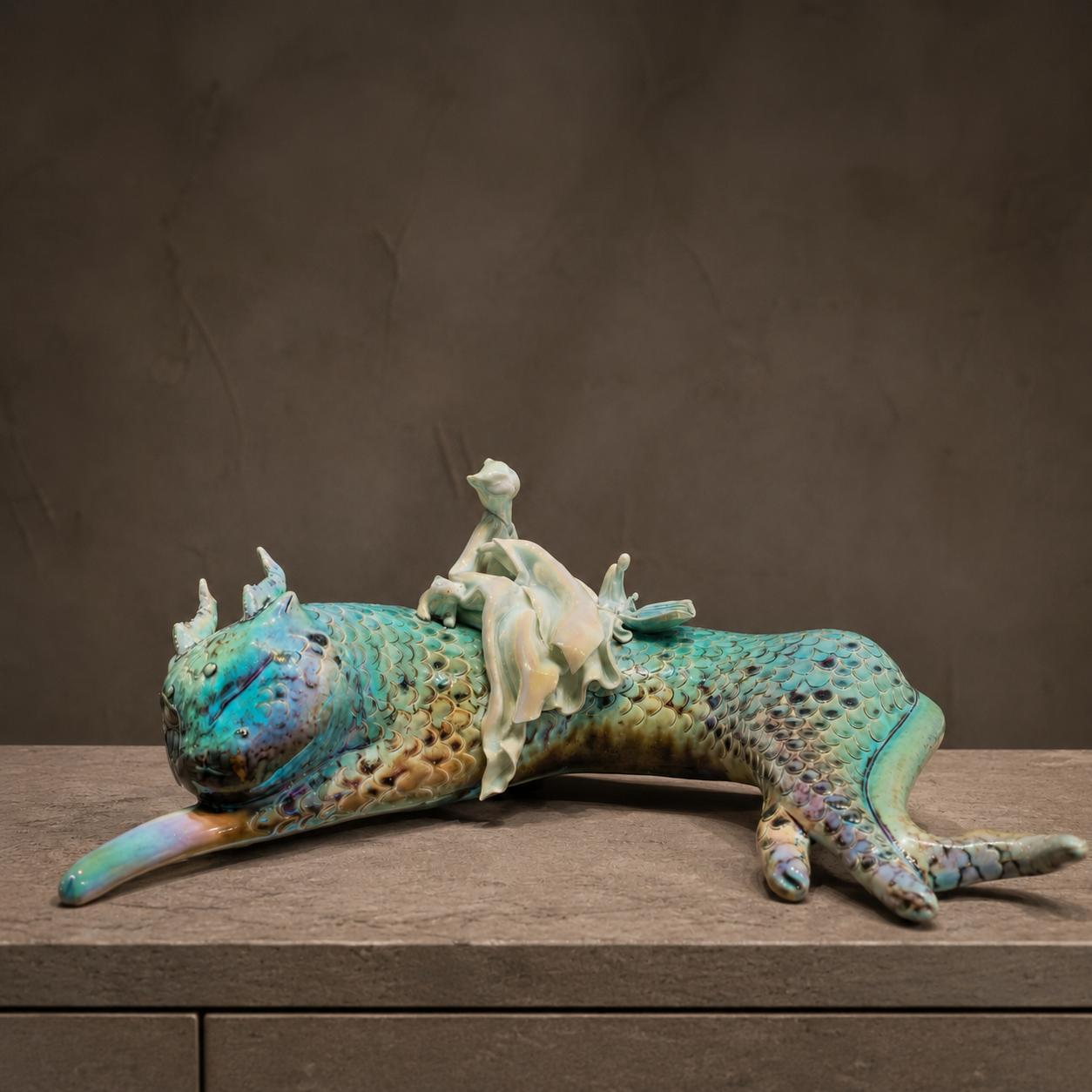
Longmao Songzi is a one-of-one handmade ceramic sculpture from Jingdezhen, created for display and collection. Its reclining auspicious-beast form, layered glaze and figures carried across the back belong to this individual work. It is not an incense burner or a functional vessel.
A Beast Carrying a Story
A horned head, long reclining body, extended limbs, dense scales and pale figures across the back read as one complete sculpture. Calm rather than imposing, the creature carries a quiet sense of protection, continuity and blessing.

Water, Mineral and Natural Oxidation
Blue-green, celadon grey, warm mineral gold and restrained violet-brown move quietly across the surface. Their layered transitions recall water, weathered minerals and natural oxidation, giving the work depth without exaggerated colour.

Changed by Fire, Never Flat
More translucent passages sit beside deeper pools of colour. Across raised and recessed surfaces, the glaze appears to flow, gather, separate and transform through firing, creating a living ceramic surface rather than a flat layer of colour.

Every Scale Holds Colour Differently
Each raised edge, inner hollow and narrow seam catches glaze in a slightly different way. Small shifts in depth, reflection and colour make the scale field richly varied while preserving the natural irregularity of work formed by hand.

A Complex Form, Made Whole
The long body, extended limbs, horned details, dense scales and figure group create a demanding sculptural structure. Its value lies in bringing these shifting and vulnerable parts through forming, glazing and firing as one complete ceramic work.

A Story Carried on Its Back
The pale figures resting across the shoulder and back create a quiet narrative of protection, continuity and blessing. Formed as part of the beast rather than as separate ornaments, they bring a gentle vertical rhythm to its long reclining body.

Made by Hand, Left Visible
Subtle differences in line, symmetry, joins and scale direction preserve the presence of the hand. These quiet variations are not defects to be erased; they are part of what makes the sculpture individual rather than mechanically repeated.